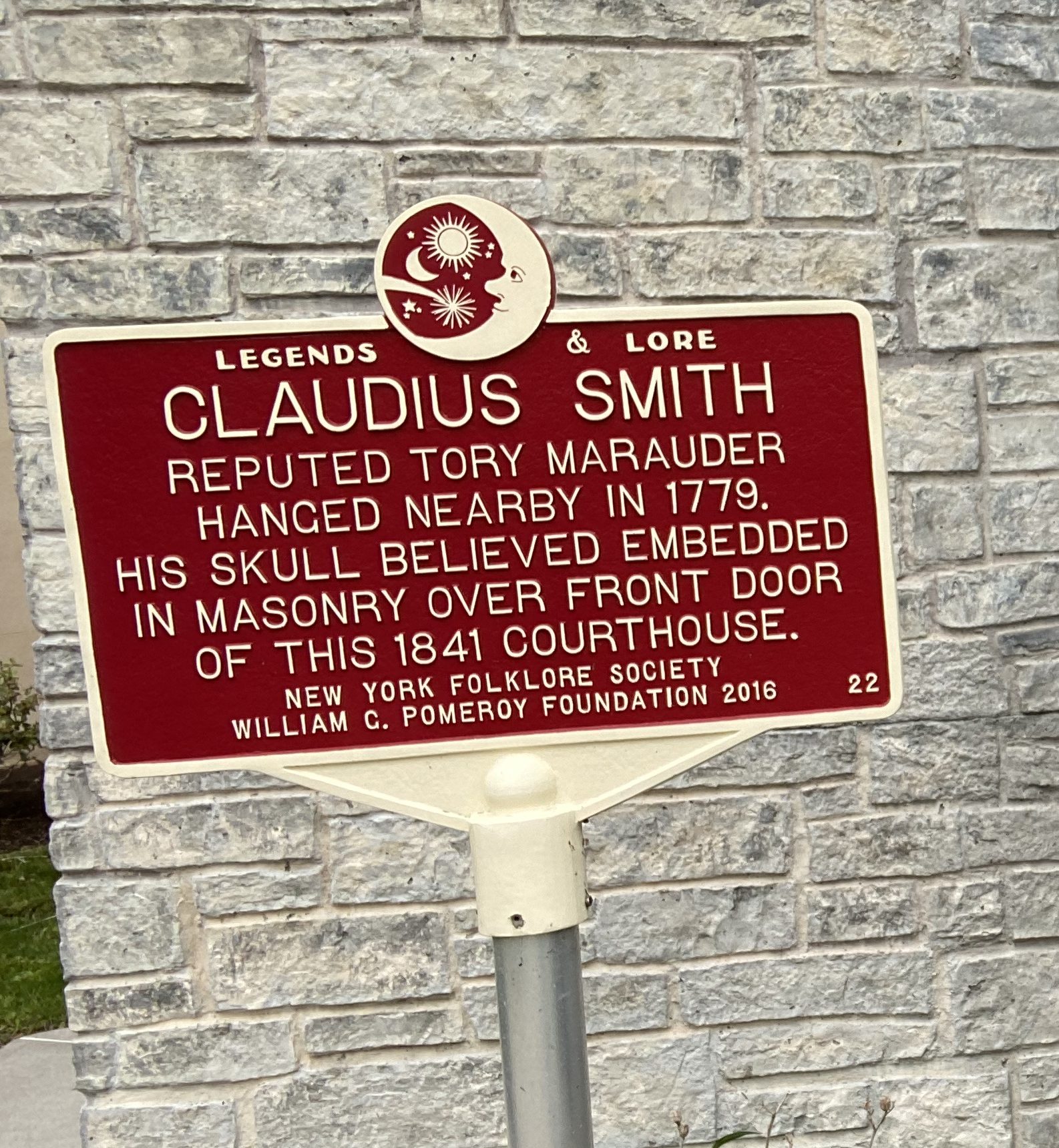
As in all things related to the Smith Gang, take with a grain of salt.
SOURCE: “History of Orange County, New York” Ruttenber EM and Clark,
LH. (Philadelphia: Everets and Peck, 1881) reprinted 1980
Claudius came to Knight’s Mill’s in the present town of Monroe with his father
“where he grew up, married and had sons…It may safely be stated that the family of Smiths were early settlers in and gave their name to Smith’s Clove. (Smith’s Clove was a valley of the Ramapo. It is an area of ponds, streams and mountain gorges. p. 801 ” Here were the hiding places of Claudius Smith and his
associates”) Claudius is described as “a man of large stature and powerful nerve, of keen penetration; one upon whom nature had bestowed abilities worthy to be exerted in a better cause. He conducted his expeditions with such cautiousness as scarcely to be suspected until in the very execution of them; and if a sudden descent was made upon him, by some bold stroke or wily maneuver he would successfully evade is pursuers and make his escape.” That he had the credit of doing much that he did not do is no doubt true; murder was not one of his offences though murder was committed; he was a “cow-boy”, a stealer of horses and cattle, perhaps of silverware and money, if he could find it and as a thief he was tried and executed at Goshen on the 22nd of January, 1779. His indictment being “for burglary at the house of John Earle; for robbery at the house of Ebenezer Woodhull; for robbery of the dwelling and still-house of William Bell.” Whatever other sins he may have committed were not charged against him. He had good qualities. It is said that ” the poor man found in him a friend ready to share both his meal and his purse, and it is believed that much of what he extracted from the wealthy he bestowed upon the indigent.” …He was hospitable … He hated meanness…” At what time he began serving the British is not known. “In July 1777, as a prisoner in Kingston Jail, in company with one John Brown, “charged with stealing oxen belonging to the contingent.” from Kingston he was transferred to Goshen, from whence it is said he escaped. In anything like a tangible record, he is next met on his capture at Long Island, in the fall of 1778, and the official narrative ends with his execution. The immediate act which led to his arrest was the murder of Maj. Nathaniel Strong, of Blooming Grove. Immediately…Governor Clinton (Oct 31, 1778) offered a reward for the apprehension of Claudius and his sons Richard and James…He was recognized [on Long Island] and… seized in his bed, and conveyed to Connecticut, where he was placed under guard. By direction of Governor Clinton…Smith was taken through Connecticut to Fishkill Landing…and
under guard of Capt. Woodhull’s troop of light-horse, taken to Goshen, where he was ironed and placed in jail. His trial was held at the Oyer and Terminer, Jan
13,1779 and his execution followed on the 23rd of the same month…His son
James is believed to have been executed at Goshen soon after his father
[probably in early summer] …his son William was shot in the mountains [near
Smith’s Clove] before his father was executed…Richard, the youngest son of
Claudius, with several members of the band, escaped to Nova Scotia after peace
was declared…”
Leave a Reply