Part of “The Clove” follows the Earl Brothers, Ben and Richard, traveling to Ulster County to purchase millstones. They journey through the New Paltz area and witness vast, fertile farmlands owned by the descendants of the founding Huguenots, worked by hundreds of enslaved people. In 1790, New Paltz, 77 slaveholders owned a total of 302 slaves, representing 13% of the population. The largest slaveholders came from well-established third- and fourth-generation French and Dutch families, including Hardenbergh, Hasbrouck, DuBois, Freer, Wynkoop, and Vandermark.
Many of the Slaves were purchased at the Slave Market on the Strand in Kingston, where they would be displayed right off boats anchored in the Roundout Creek there.

Enslaved people were purchased and brought to New Paltz. They were usually kept in the basements, kitchens, or attics of their owners, though some were also kept in outbuildings. Conditions were terrible and only slightly better for the higher-skilled. A family of enslaved people was always in danger of being split up if they weren’t all benefiting their owner’s needs.
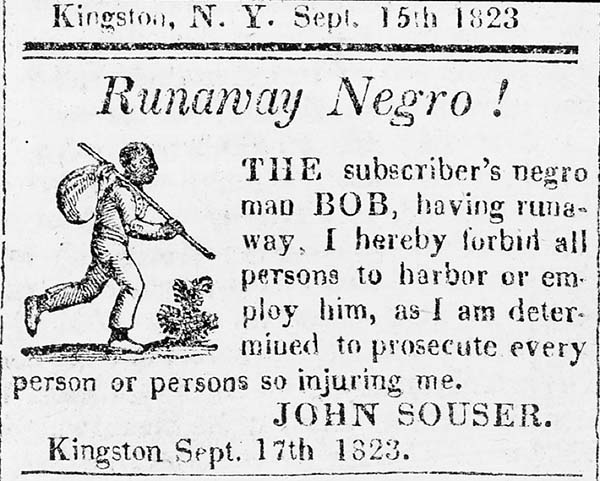
It became common for slaves to run away.
Newspaper advertisements offering rewards for runaway slaves in Ulster County detail the slaves’ desire for freedom. A group of slave owners in New Paltz banded together to form “The Society of Negroes Unsettled” to search for and apprehend runaways. The runaways took their lives in their hands running away, and people who aided their escape could be fined and jailed as well. Some Quakers and Presbyterians, among whom were the beginnings of the abolitionist movement, risked arrest by helping escapees. All of these facts are presented in The Clove, and I have tried to keep this part of our history as real as possible.
Slavery was officially abolished in New York State on July 4, 1827. While a gradual emancipation act was passed in 1799, the final, total abolition of legal slavery for all enslaved people in the state did not take effect until 1827. New York was the first state to pass such a total abolition law.

This is Caesar. The last man to have been a slave in New York. He lived to 115.
Leave a Reply